Degree: B.Tech. in Polymer Engineering
GPA: 8.82/10.00
- Thesis: High Impact Resistant Polyolefin Blends for Houseware Applications.
- Motivation: Polyolefins are commonly used in houseware and bottle applications. However, they suffer from low impact and tear resistance limiting their load bearing capability.
This can be improved using copolymerization, chemical modification or blending with higher impact resistant materials.
In this work, polymer blending was leveraged, considering it is an easier and cost effect method to modify properties.
Homopolymer and random copolymer polypropylene was used as the base polymer while poly(ethylene-co-octene) and styrene-butadiene-styrene rubber were used as additives to improve properties.
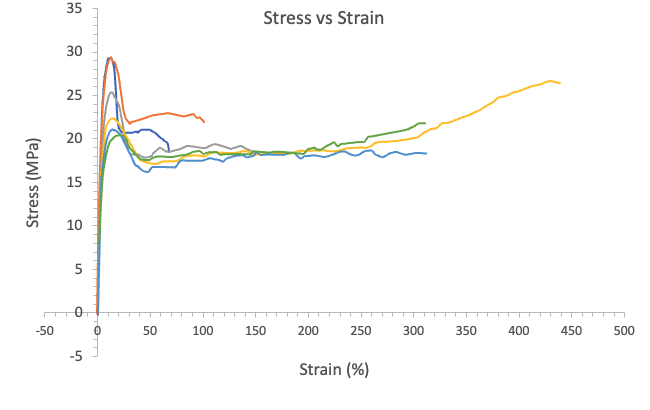
- Key Challenges: Determining appropriate blending material to meet performance targets; optimizing blend phase separation through concentration, material type and process experiments;
compatibliizing blends to avoid structural defects; developing a blow-molding compatible blend for bottle application.
- Accomplishments: Determined target materials specification using maket and industry survey of houseware products;
studied blend using 2 elastomer systems for mechanical and viscoelastic properties;
improved properties using a compatibilizer additive;
determined an optimized blend composition with 8x impact resistance and 3x elongation before break compared to the unblended polypropylene, without significantly reducing tensile strength.
- A. Cintora, H. Takano, M. Khurana, A. Chandra, T. Hayakawa, C. Ober, “Block copolymers containing
stable radical and fluorinated blocks with long-range ordered morphologies prepared by anionic polymerization,” Polymer Chemistry 10, 5094, (2019). link🔗
- Mohit R. Khurana, Alicia Cintora, Christopher Ober, “Directed Self Assembly of a Stable Radical Polymer”
2018-2019 Research Accomplishments CNF, page 200, 2019. link🔗
- N. Badwe, P. Daharwal, T. Rawlings, P. Diglio, S. Wozny, M. Khurana, P. Tadayon, G. Hsieh, M. Renavikar, “High-temperature mechanical properties and fatigue of nanocrystalline nickel-cobalt-phosphorous
(NiCoP) alloy,” Materialia. 18, 2589, (2021). link🔗
- Y. Yang, M. Wall, R. Shanmugam, S. Wozny, X. Yan, M. Khurana, R. Ranjan, D. Seneviratne, K.
Nikkhah, S. Nad, “Characterizations and Challenges of Adhesion Promotion Solutions for HSIO Package
Development”, 2022 IEEE 72nd Electronic Components and Technology Conference (ECTC), San Diego,
CA, USA. 648, (2022). link🔗
- M. Ayalasomayajula, M. Ravi Khurana, V. Balakrishnan, P. Shiva Chaudhary, S. Basu Bal and R. Kumar
Baranwal, “Advancements in Wearable Solar Cell Technology: Integrating Perovskites and Dye-Sensitized
Cells,” IEEE Journal on Flexible Electronics, vol. 3, no. 5, (2024). link🔗
- M. Khurana, M. Ayalasomayajula, P. S. Chaudhary “Selective Atomic Layer Etching for Silicon Device
Fabrication,” IEEE ICIC3S, Una, India, (2024). link🔗
- M. Ayalasomayajula, M. Khurana, P. S. Chaudhary "Effects of process parameters on Ga2O3 fabricated by MBE, HVPE and MOCVD"
IEEE ICIC3S, Una, India, (2024). link🔗
- M. Ayalasomayajula, M. Ravi Khurana, P. S. Chaudhary, “Electrically Conductive Adhesives in Microelectronics Packaging,” ASME. J. Electron. Packag, 1-8, (2024). link🔗

SME 30 Under 30 🏆
Year: 2025
Awarded by SME
SME spotlights the significant talent, contributions and innovation of young people impacting the future of manufacturing.


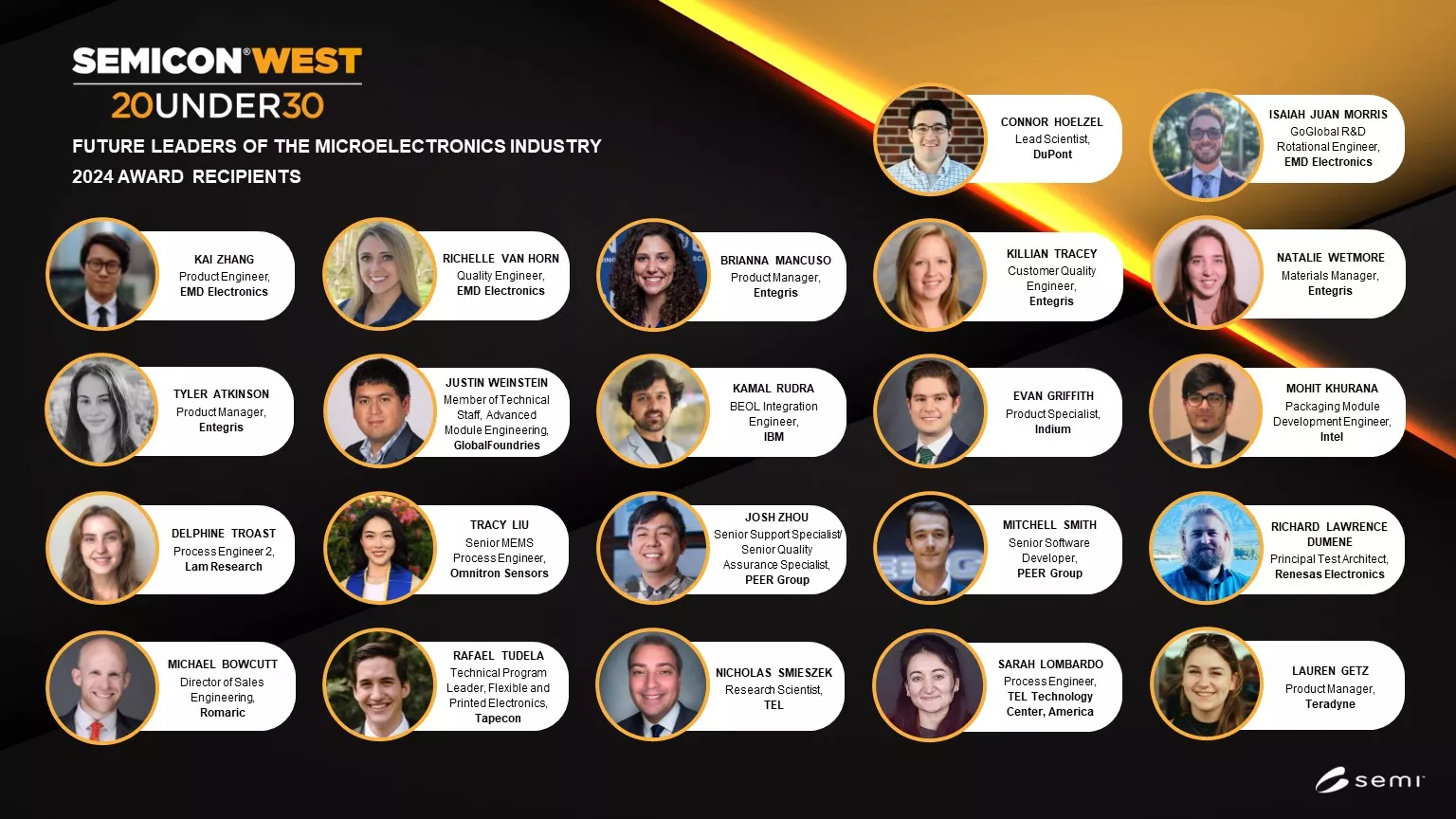
Semicon West 20 Under 30 🏆
Year: 2024
Awarded by SEMI Americas
For demonstrating outstanding leadership, practicing productive collaboration, exhibiting commitment to success and actively engaging in the community.

Senior Member of the IEEE 🏛️
Elected Senior Member since 2026.
About the organization: IEEE is the Institute of Electrical and Electronics Engineers. It formed in 1963, when the American Institute of Electrical Engineers (AIEE) merged with the Institute of Radio Engineers (IRE). IEEE’s members are engineers and technologists from around the world.
Organization Website 🔗

Member of the Royal Society of Chemistry 🏛️
Elected Member since 2025.
About the organization: UK’s professional body for chemical scientists with a worldwide community.
Organization Website 🔗

Member of the IEEE EPS Technical Committee on Emerging Technologies 🏛️
Committee Member since 2023.
About the committee: Focuses on emerging, novel and unique material and packaging solutions. This committee places an international focus on the development, characterization, and commercial support for packaging, assembly, and test infrastructure for key applications areas such as, Fluidic Systems, Optical Systems, Automotive Systems, Military Systems, Medical Systems, Remotely Operated Systems, Telecommunications.
Committee Website 🔗
Research Interests
- Advanced packaging architectures: Novel architectures that scale to larger die complexes, higher bandwidths, higher thermally designed power and efficient system-level i/o.
- Advanced packaging interconnects: Development of reliable high density silicon interposer interconnects, silicon bridge interconnects, hybrid bonded interconnects, and optical interconnects.
- Substrate technology: Development of substrate core technology, build-up technology, bump pitch scaling, power delivery and HSIO for large multi-die packages.
- Warpage control and stress mitigation for AI GPUs and large form-factor packages through on and within package technologies like stiffener and substrate core.
- Novel packaging materials for wafer and package assembly.
- Advanced packaging characterization and defect detection.
Benefits and Drivers for Advanced Packaging
- Enables heterogeneous integration of chiplets and components on the same package. Examples: HBM memory, compute and graphics processing units on the same package.
- Enables disaggregation of chiplets into smaller sizes to improve yield resilience.
- Enables customization of die-die interconnections with benefits such as leveraging different and custom IPs on the same package, use of different i/o densities at different interfaces, etc.
- Enables improved off-package communication on the system level to improve system performance.
- Enables advanced thermal solutions on the package and system level, to keep up with the growing thermal demands with compute scaling.
- Enables high speed I/O and power delivery solutions to meet growing data rate, thermally defined power requirements.
What is a Semiconductor Package?
Why is Packaging Needed?
Standard vs Advanced Packaging


 My Google Scholar Profile